

Playback Configuration
Once the software has loaded, navigate to Play > Setup > Playback Devices. To make use of the SoundSet, you’ll need to create a new, or modify an existing, Playback Configuration. We’ll create a new one here:
- Click on the “New” button. A new configuration will allow you to add other devices if needed.
- Name the new configuration to suit your liking.
- Activate Sibelius Player. Double click the field under “Sound Set” to get the sound set drop down menu, select the S7S-SE6 SoundSet 7.1a sound set. Save the configuration.
- Close the dialog.
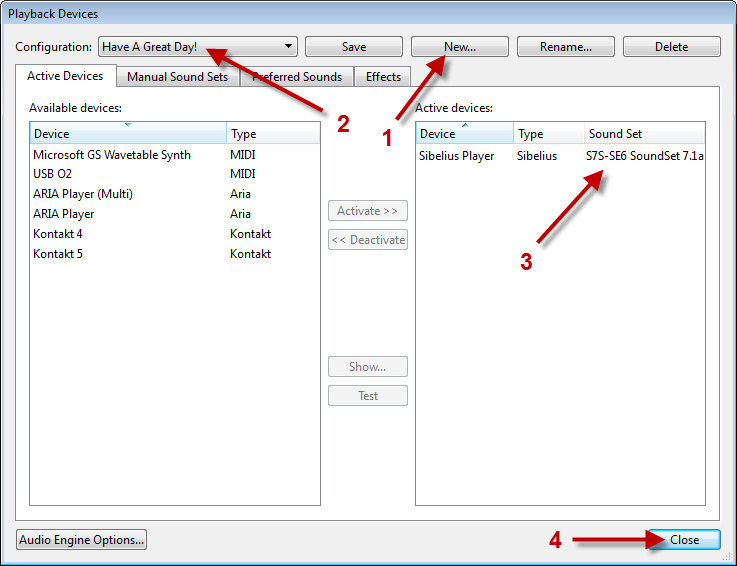
In order to help you find the required sound set in the Sound Set drop down menu, we modified the name in regards to how it will show up in Sibelius. Be sure to select and assign the sound set labeled “S7S-SE6 SoundSet 7.1a”.
NOTE: When you’d like to use the Lite sound set, choose the one that is labeled “S7S- SE6 SoundSet 7.1a Lite”. Sibelius will take care of the rest.
The one instance of Sibelius Player that is available can accommodate up to 128 instruments. The default setting in Preferences for the number if instruments that can be loaded into it will vary depending on how much RAM you have in your computer. If have only 2 GB of memory, it will probably default to a limit of 64 instruments. And you’ll more than likely run out of available memory before you run out of available slots, even when using Sibelius in 64-bit mode.
RECAP:
- You’re running Sibelius 7+
- You’re running the latest version of the S7S library
- You’re running the SE6 library (Essentials for Sibelius 6)
- You’ve installed the sound sets: “S7S-SE6SoundSet7.1a” and “S7S-SE6SoundSet7.1a Lite”
- You’ve created a playback configuration that will use these new sound sets.
With the above steps completed, it’s time to open up a .sib file and get working!